


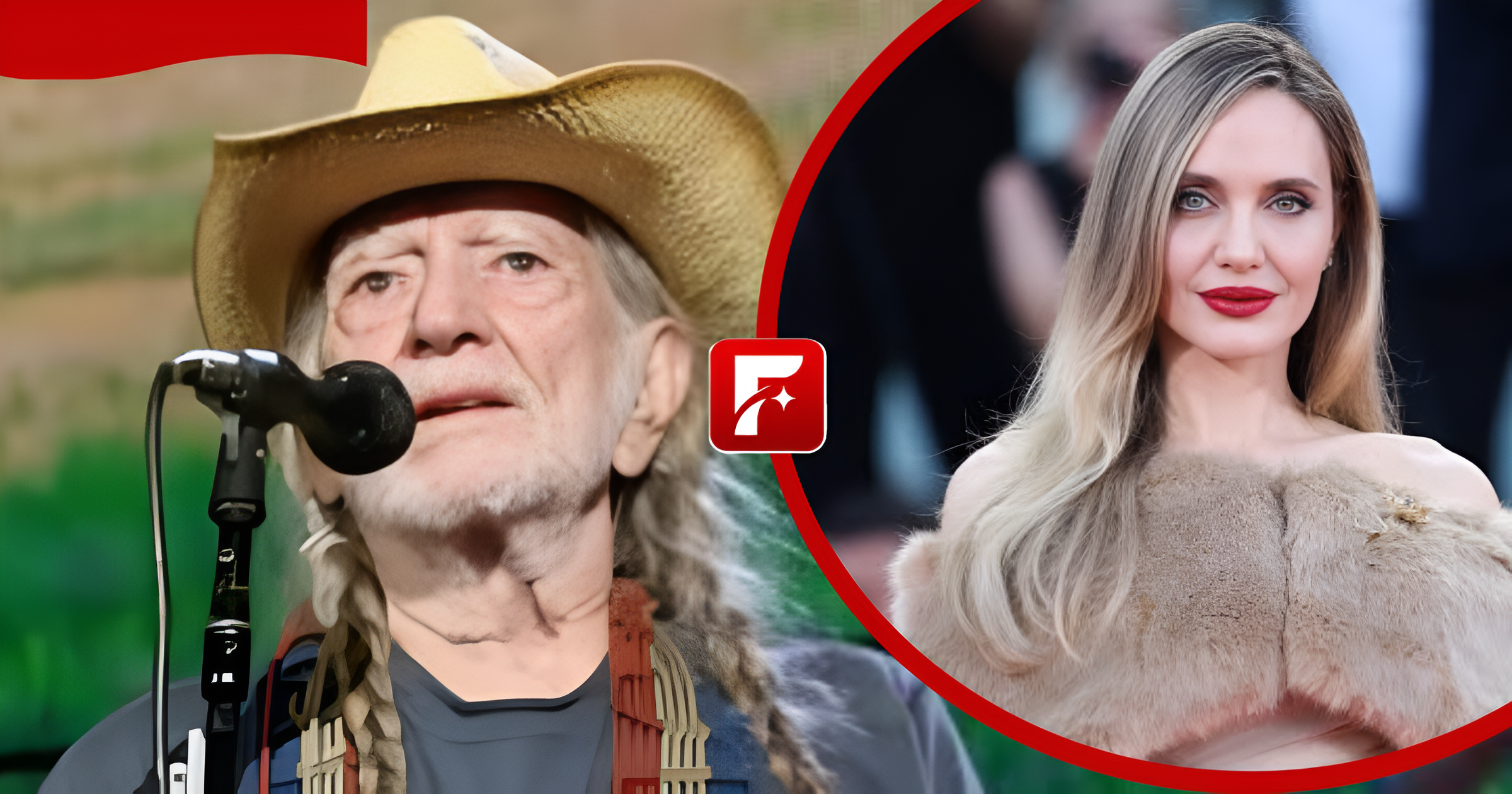
Few pairings seem as unlikely on paper as Willie Nelson and Angelina Jolie. One is a 90-something outlaw country legend who has spent decades touring with a battered acoustic guitar named Trigger. The other is an Academy Award-winning actress, filmmaker, and humanitarian who has spent her career moving between Hollywood premieres and refugee camps. They don’t share a genre, a generation, or an industry. Yet their names keep showing up together in the same breath, and once you look closer, the reason isn’t really about any personal connection at all — it’s about what happens when two people refuse to be boxed into a single, tidy public image.
This article looks at who Willie Nelson and Angelina Jolie actually are, the very different paths that made each of them legendary, and why comparing two such different careers still tells us something real about what lasting cultural influence looks like. It’s a comparison rooted in contrast rather than connection, but that contrast is exactly what makes it worth exploring in detail.
Quick Bio Table: Willie Nelson
| Fact | Details |
|---|---|
| Full Name | Willie Hugh Nelson |
| Date of Birth | April 29, 1933 |
| Place of Birth | Abbott, Texas, United States |
| Nationality | American |
| Profession | Singer-songwriter, musician, actor, and activist |
| Famous Role / Known For | Pioneer of the outlaw country music movement |
| Years Active | Since the late 1950s |
| Net Worth | Estimated at around $20 million, following a well-publicized IRS settlement in the 1990s |
| Marital Status | Married |
| Spouse | Annie D’Angelo (married 1991); previously married to Martha Matthews, Shirley Collie, and Connie Koepke |
| Children | Seven, including Lana, Susie, Willie Jr., Paula, Amy, Luke, and Jacob |
| Notable Works / Achievements | Red Headed Stranger and Stardust albums; co-founder of Farm Aid; 12 Grammy Awards; decades-long advocacy for marijuana legalization and farmers’ rights |
Quick Bio Table: Angelina Jolie
| Fact | Details |
|---|---|
| Full Name | Angelina Jolie Voight |
| Date of Birth | June 4, 1975 |
| Place of Birth | Los Angeles, California, United States |
| Nationality | American |
| Profession | Actress, filmmaker, and humanitarian |
| Famous Role / Known For | Academy Award-winning actress and longtime UNHCR Special Envoy |
| Years Active | Since the early 1990s |
| Net Worth | Estimated at around $120 million |
| Marital Status | Divorced |
| Spouse | Formerly married to Jonny Lee Miller, Billy Bob Thornton, and Brad Pitt |
| Children | Six, including three biological and three adopted children |
| Notable Works / Achievements | Academy Award for Girl, Interrupted; global humanitarian advocacy work with UNHCR; public disclosure of her preventive double mastectomy, which led to a measurable rise in genetic testing awareness worldwide |
Who Is Willie Nelson?
Willie Hugh Nelson was born on April 29, 1933, in Abbott, Texas, during the depths of the Great Depression. His parents separated shortly after his birth, and he was raised largely by his grandparents, who gave him his first guitar at age six and introduced him to gospel singing in the local church choir. He wrote his first song at seven and was already playing in a local band by the time he was nine — an early start that set the tone for a career built almost entirely around relentless, lifelong songwriting.
For More Read: Charles Ezekiel Mozes: Cynthia Nixon’s Son
After a stint in the U.S. Air Force and a brief run at Baylor University, Nelson worked as a radio disc jockey across Texas and the Pacific Northwest while writing songs on the side, several of which — including “Crazy” and “Funny How Time Slips Away” — went on to become genre-defining standards recorded by other artists before Nelson became a star in his own right.
Building the Outlaw Country Movement
Nelson’s move to Nashville in the early 1960s gave him a foothold in the industry, but it was his eventual break from Nashville’s polished, tightly controlled sound that defined his legacy. Frustrated with the corporate music scene, he relocated to Austin, Texas, in the early 1970s and helped pioneer what became known as outlaw country — a rougher, more personal, and more independent style that pushed back against the conventions of mainstream Nashville production.
Albums like Shotgun Willie, Red Headed Stranger, and Stardust cemented his reputation as one of the most versatile songwriters in American music, capable of moving between country, blues, jazz, and pop influences without losing his distinct voice. Alongside his music career, Nelson became a co-founder of Farm Aid in 1985, an annual benefit concert supporting American farmers that he has performed at every single year since its inception, and he has remained a vocal advocate for marijuana legalization for decades.
Who Is Angelina Jolie?
Angelina Jolie Voight was born on June 4, 1975, in Los Angeles, the daughter of Oscar-winning actor Jon Voight and French-Canadian actress Marcheline Bertrand. Despite being born into Hollywood royalty, her early life was far from simply glamorous; her parents separated when she was just a year old, and she was raised primarily by her mother, who set aside much of her own acting career to focus on raising Angelina and her brother, James Haven.
Jolie’s early acting career in the 1990s built steadily, culminating in a breakout Academy Award win for her supporting role in Girl, Interrupted. From there, she became one of the most bankable and recognizable actresses in Hollywood, known for a wide range of roles that spanned major action franchises and more serious dramatic work alike.
From Movie Star to Global Humanitarian
What distinguishes Jolie from many of her Hollywood peers is the depth of her humanitarian work, which has become just as central to her public identity as her acting career. Her role as a UNHCR Special Envoy has taken her to conflict zones and refugee camps across Africa, Southeast Asia, the Middle East, and Eastern Europe, and she has testified before the U.S. Senate and co-authored a book addressing sexual violence in conflict zones.
Perhaps her most measurable public impact came in 2013, when she disclosed her preventive double mastectomy in a widely read op-ed. The disclosure led to a well-documented rise in genetic testing referrals for the BRCA gene in multiple countries, a phenomenon researchers have since referred to as “the Angelina Effect” — a rare example of a celebrity disclosure translating directly into measurable public health outcomes.
Why Are Their Names Often Paired Together?
There’s no personal or professional relationship connecting Willie Nelson and Angelina Jolie. The pairing comes almost entirely from editorial comparison pieces built around a shared theme: both are considered enduring, larger-than-life figures who built reputations on refusing to conform to industry expectations. Nelson rejected Nashville’s polished commercial sound in favor of a rougher, more personal style. Jolie built a public identity that extended well beyond typical Hollywood celebrity, using her platform for advocacy work with real, documented consequences.
Two Very Different Definitions of Longevity
Comparing their careers side by side highlights two different models of staying power in public life. Nelson’s longevity comes from consistency — decades of steady touring, songwriting, and a public persona that has remained recognizably the same since the 1970s. Jolie’s longevity comes from reinvention — moving fluidly between acting, directing, humanitarian advocacy, and public health messaging in a way that has kept her relevant across shifting cultural moments rather than through a single unchanging image.
Both approaches have proven remarkably durable, just through very different mechanisms. Nelson’s authenticity lies in never appearing to change. Jolie’s relevance lies in her willingness to continuously expand what her public role represents.
What Their Personal Lives Reveal About Public Resilience
Both figures have also weathered significant personal turbulence in full public view. Nelson has been married four times, has spoken candidly in recent years about past infidelities and family strain, and endured a highly publicized battle with the IRS in the 1990s over a multimillion-dollar tax debt that he eventually paid off in full. Jolie’s personal life, including her marriages to Jonny Lee Miller, Billy Bob Thornton, and Brad Pitt, has also played out extensively in the public eye, including a widely covered divorce from Pitt.
What stands out in both cases is the way each of them has continued building their public legacy despite, rather than in spite of, that personal turbulence. Neither allowed personal setbacks to derail their broader body of work, which is arguably part of why both are remembered today more for their lasting contributions than for any individual controversy.
How Each of Them Uses Their Public Platform Today
It’s worth looking at how both figures continue to operate publicly well into the later stages of their careers, since it says something about how they’ve each chosen to age within the public eye. Nelson, now in his 90s, continues to tour actively and maintains a direct connection with fans through his official website and social media presence, where his team shares performance updates alongside his continued cannabis advocacy work. He doesn’t perform a version of himself for the cameras; by most accounts from those who’ve worked with him, the public Willie Nelson and the private one are essentially the same person, which is part of why his authenticity has never really been questioned over a career spanning more than seven decades.
Jolie’s use of her public platform looks quite different, reflecting the different demands of her industry and advocacy work. Her social media presence blends film promotion with humanitarian messaging, refugee crisis awareness, and glimpses into her family life, creating a carefully balanced public identity that serves multiple purposes at once. During major humanitarian crises, she has used her platform to publish open letters and direct her audience toward concrete, actionable ways to help — a more curated and purposeful approach to public communication than Nelson’s more straightforward, tour-and-perform style of engagement.
A Shared Willingness to Age Publicly Without Apology
Despite these different approaches, both figures share something increasingly rare among aging public figures: neither has tried to hide or downplay the passage of time. Nelson continues to perform well into his 90s without pretending to be anything other than an elder statesman of American music, while Jolie has spoken candidly about aging, motherhood, and the toll of public scrutiny rather than projecting an artificially youthful image. That kind of honesty about time passing, rather than resistance to it, may be one of the more understated reasons both have maintained such enduring public goodwill.
Why This Kind of Comparison Resonates With Readers
Placing two figures from entirely separate industries side by side works because it highlights a pattern readers instinctively recognize: genuine cultural staying power rarely comes from talent alone. It comes from a combination of talent, authenticity, and a willingness to use a public platform for something larger than personal fame. Readers who enjoy exploring how vastly different public figures arrive at similarly enduring legacies, similar to profiles found on <a href=”https://fameora.blog/”>Fameora</a>, often find this kind of comparison genuinely illuminating precisely because the two subjects have nothing obvious in common at first glance.
Lessons From Two Completely Different Careers
There’s a broader takeaway worth pulling from comparing Willie Nelson and Angelina Jolie directly. Nelson’s career shows that consistency, paired with a refusal to compromise creative identity for commercial convenience, can produce a legacy that spans generations. Jolie’s career shows that using fame as a platform for tangible, measurable impact — rather than treating public visibility as an end in itself — can create a legacy that extends well beyond box office numbers or awards.
Neither path is replicable in any formulaic sense, but both offer a genuine blueprint: build something real, stay authentic to it even under public scrutiny, and let that authenticity — not image management — become the foundation of lasting cultural relevance. It’s a lesson that applies well beyond music or film, and one that helps explain why both names continue to resurface in conversations about what it really means to remain culturally significant over an entire lifetime rather than a single fleeting moment.
Frequently Asked Questions
Do Willie Nelson and Angelina Jolie have any personal or professional connection? No. There is no documented personal relationship or professional collaboration between them. Their names are typically paired in comparison-style articles exploring cultural longevity and public resilience.
What is Willie Nelson best known for? He is best known for pioneering the outlaw country music movement and for classic songs including “On the Road Again” and “Always on My Mind.”
What is Angelina Jolie best known for? She is best known for her Academy Award-winning role in Girl, Interrupted, her extensive humanitarian work with UNHCR, and her public health advocacy following her preventive double mastectomy.
How many times has Willie Nelson been married? He has been married four times, most recently to Annie D’Angelo since 1991.
Is Angelina Jolie currently married? No. She is divorced, having previously been married to Jonny Lee Miller, Billy Bob Thornton, and Brad Pitt.
What is “the Angelina Effect”? It refers to the documented rise in genetic testing referrals for the BRCA gene after Angelina Jolie publicly disclosed her preventive double mastectomy in a 2013 op-ed.
How many children does Angelina Jolie have? She has six children, three biological and three adopted.
Conclusion
Willie Nelson and Angelina Jolie built their legacies in completely separate worlds, decades apart, with no personal connection linking them beyond how frequently their names appear together in cultural comparison pieces. Nelson’s staying power comes from decades of consistent, unfiltered songwriting and a refusal to conform to industry expectations, while Jolie’s comes from a willingness to continuously expand her public role from actress to global humanitarian advocate.
